Shape is the part of a set people decide last and live with longest. It changes how a set wears, how quickly it chips, and whether it gets in your way at work or on a keyboard.
The same shape can look right on one hand and wrong on another, too. Here are the five you'll hear most often, what each one suits, and what it's actually like to wear.
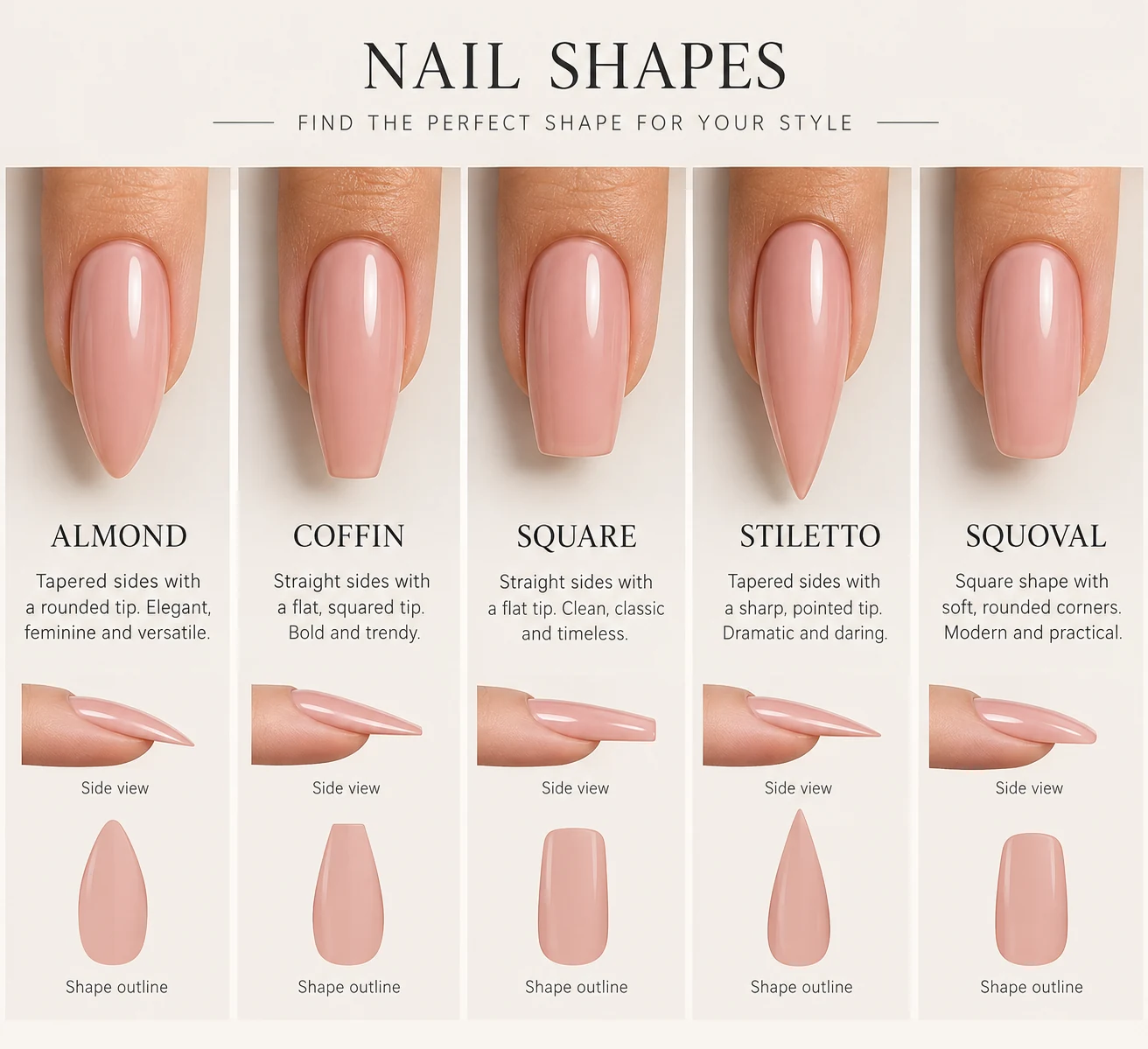
Almond
What it is: slimmer at the tip than at the base, ending in a soft point. Think of the nut it's named after.
Who it suits: almost everyone. The taper draws the eye along the finger, so it makes shorter fingers and wider nail beds look longer and slimmer. It needs some length past the fingertip to form the taper; filed too short, it becomes an oval.
How it wears: well. There are no corners to catch or chip, and the rounded point spreads a knock rather than taking it on one spot. The tip is the narrowest part, so that's where you'll see wear first.
Living with it: it's one of the easier shapes to forget you're wearing. Typing is fine at a moderate length. Gloves go on without snagging. It doesn't catch on knitwear or hair the way a squared edge can. If your hands are busy all day, keep it on the shorter side and it holds up.
Coffin
What it is: long, tapering in from the sides to a flat, narrow end. It's also called ballerina.
Who it suits: anyone who wants length and a shape that reads clearly from across a room. It needs real length to look like coffin at all, so it's almost always built as an extension rather than on natural nails. Which product that should be is its own question, and it's the one we answer in Gel-X or acrylic.
How it wears: the two corners at the flat end are where it takes damage. They chip or lift first, and a knock on one corner puts a lot of force on a small area. It needs refills on schedule, because as it grows out the balance point moves forward and the tip starts catching on things.
Living with it: plan around the length. Type with the pads of your fingers, not the tips. Tight gloves need a little care going on. Picking up coins, opening cans and doing up small buttons all take a moment to relearn. None of it is hard, but you'll notice it in the first week.
Square
What it is: cut straight across the end, with crisp, defined corners.
Who it suits: longer, narrower nail beds, where a straight edge looks clean. It works at any length, including short on natural nails. On short, wide nail beds it can make nails look wider than they are.
How it wears: the corners are the weak point. They're the first thing to catch, and on natural nails they're where splits start. Everything else about the shape is sturdy: a flat, wide edge doesn't break easily.
Living with it: square is at its most practical kept short. At length, the corners catch on knitwear, pockets and tights. If you like the look but find the corners annoying within a week, squoval is the same shape without that problem.
Stiletto
What it is: long, and narrowing all the way to a fine point.
Who it suits: anyone after a dramatic set, on almost any nail bed. It needs length and strength to hold a point, so it's done as an extension, not on natural nails.
How it wears: the point is thin, so it's the most likely shape to break at the tip if it's knocked. It needs regular maintenance to keep the point sharp and even, and a break is obvious straight away.
Living with it: this is the shape that asks the most of your week. Typing, texting, doing up buttons and zips, putting in contact lenses and washing your hair all need some adjustment. Gloves can be poked through at the fingertips. Plenty of people wear it happily for years, but if your job is hard on your hands, it's worth being honest with yourself about that before you book.
Squoval
What it is: straight sides and a flat tip, like square, with the corners filed soft so there's no sharp point at either side.
Who it suits: nearly every nail bed, and it's the most forgiving choice on natural nails and at short lengths. If you're not sure what you want, it's a safe place to start.
How it wears: better than square. With the corners softened, there's nothing to catch, so it chips and splits less. It grows out gracefully, so it still looks tidy late in a set.
Living with it: this is the practical choice for hands that work hard. It stays out of the way on a keyboard, goes into gloves without catching, and suits a shorter manicure on natural nails as well as it suits a set.
Still not sure?
You don't need to arrive knowing. The easiest thing to do is bring a photo of a set you like, even if it's a different colour or length from what you want. It shows the shape better than any description.
Shape isn't fixed at booking, either. Tell your technician what your week looks like, and the shape and length can be adjusted in the chair before anything is finished.